African countries that do not have coconut trees
Africa is a continent of breathtaking climatic extremes — the world's largest desert in the north, equatorial rainforests straddling the middle, towering volcanic plateaus in the east, and arid steppes in the south. It is also home to 55 sovereign nations, more than half of which cannot grow a single productive coconut tree.
Not because coconuts are rare, but because the coconut palm is one of the most demanding crops on Earth, requiring a very precise combination of warmth, humidity, low altitude, and tropical latitude that vast swaths of Africa simply do not offer.
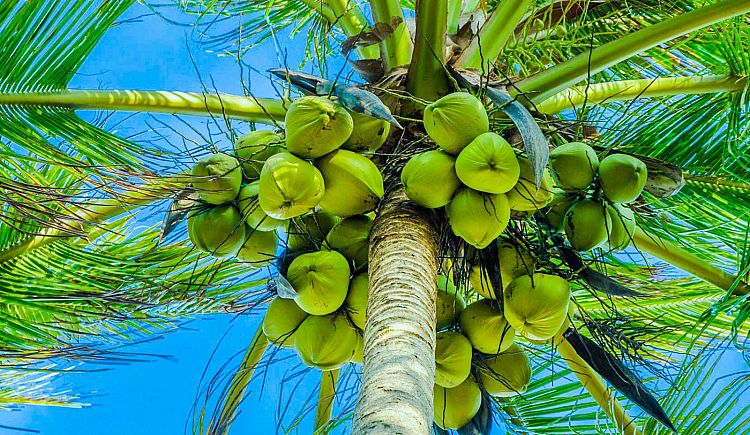
The coconut palm (Cocos nucifera) thrives only between 23°N and 23°S latitude, at altitudes below 600 metres, in temperatures between 22°C and 34°C, with humidity above 60 per cent and annual rainfall of at least 1,500 mm, well distributed across the year.
Step outside these parameters – as so many African countries do – and the coconut palm cannot survive, let alone bear fruit.
READ MORE: L.I. 2519: Full list of road traffic offences and jail terms in Ghana
The Desert Belt: North Africa
The most obvious barrier is the Sahara. Stretching across the entire northern third of the continent, it is the world's largest hot desert — and its climate is the polar opposite of what coconut palms need. The five nations of North Africa — Algeria, Libya, Tunisia, Morocco, and Egypt — all lie north of the Tropic of Cancer (23.5°N), placing them entirely outside the tropical band where coconuts can grow commercially.
Algeria and Libya are more than 90 per cent desert. Tunisia, the northernmost country on the African continent, stretches to 37°N—where Mediterranean winters regularly kill off frost-intolerant plants. Morocco's Atlas Mountains and arid Atlantic coast offer no tropical refuge. Egypt is approximately 96 per cent hyper-arid desert; while the Nile Delta supports agriculture, it cannot provide the year-round humidity coconut palms demand. A few ornamental specimens may survive in coastal resort zones, but there is no coconut industry of any kind across the entire North African region.
The Highland Trap: Landlocked Plateau Nations
Africa has more landlocked countries than any other continent — sixteen in total. Many of these sit on elevated interior plateaus where altitude alone rules out coconut cultivation, regardless of how tropical the latitude might be.
Lesotho is perhaps the most extreme case. It is the only country in the world where every single point of its territory sits above 1,000 metres above sea level. Snow falls on its Drakensberg peaks each winter. Coconut trees have no chance here. Ethiopia, the world's most populous landlocked nation, has its capital, Addis Ababa, at 2,355 metres — nearly four times the coconut palm's maximum tolerable altitude. Rwanda, known as the Land of a Thousand Hills, averages above 1,500 metres across its entire territory, with misty temperatures that regularly fall below 20°C – the absolute minimum for coconut survival.
The same logic applies across Burundi, Uganda, Zambia, Zimbabwe, Malawi, and Eswatini. All occupy portions of the central and eastern African plateau, sitting anywhere from 900 to 2,000 metres above the sea. They lie within tropical latitudes, yet their elevation eliminates them from the coconut map entirely. None appear in any African coconut production statistics.
The Sahel: Too Dry, Too Landlocked
South of the Sahara lies the Sahel — a vast semi-arid band stretching from Senegal in the west to the Horn of Africa in the east. Nations including Mali, Niger, Burkina Faso, Chad, and South Sudan occupy this climatically brutal zone. Annual rainfall in the Sahel ranges from under 300 mm in the north to barely 1,000 mm at its southern edge — still well short of the 1,500 mm minimum that coconut palms require. These countries are also landlocked, removing any possibility of the warm, breezy coastal microclimate that coconuts prefer. Recurring droughts, intense heat, and near-zero humidity seal their fate.
Niger is approximately 80 per cent Sahara Desert — one of the driest countries on Earth. Mali is not far behind. The Central African Republic, though closer to the equator and technically in a tropical zone, is landlocked and lacks the coastal sandy soil environment where coconut palms naturally take root and thrive.
The Southern Fringe: Too Arid, Too Far South
Below the tropics, the story repeats. Botswana is largely the Kalahari Desert — landlocked, with annual rainfall often under 500 mm and erratic distribution. Namibia is one of the driest countries on the planet; its Atlantic coastline is dominated not by a warm tropical ocean but by the cold Benguela Current, which chills the coast and suppresses all moisture. South Africa, for all its agricultural diversity, lies almost entirely below 23°S. A handful of ornamental palms survive on the warmer KwaZulu-Natal coast, but there is no coconut industry. The Mediterranean Western Cape, the cold interior Highveld, and the semi-arid Karoo make South Africa fundamentally unsuited to coconut cultivation.
Even coastal Djibouti and Eritrea — despite touching warm seas — fail the test. Djibouti receives roughly 150 mm of rainfall a year and bakes in desert heat with near-zero humidity; it's the wrong kind of tropical entirely. Eritrea's coast is arid desert; its interior is a cool highland plateau. Neither zone comes close to what a coconut palm needs.

Edem Kwame
Chief Editor
Edem Kwame is a staff journalist at GH News Media, where he covers news, sports, politics and current affairs with a sharp focus on Ghanaian and African football.