Facts about 2026 FIFA World Cup ball every player must know
Football is, at its core, a beautifully simple game. In theory, all you need is something round and a patch of ground. But the official match ball for FIFA World Cup 2026™ is proof that at the highest level of the sport, every detail matters, and this ball may be the most technically advanced piece of football equipment ever put into play.
What Is the TRIONDA?
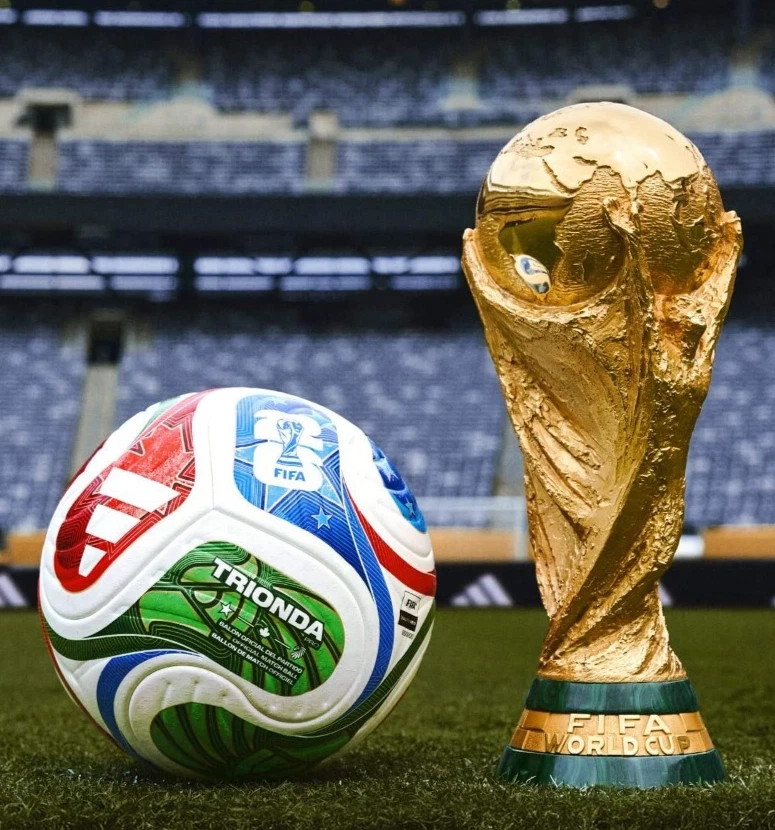
Revealed by FIFA and Adidas on October 2, 2025, in New York City, the TRIONDA is the official match ball of the 2026 FIFA World Cup, co-hosted across Canada, Mexico, and the United States.
The name itself tells the story. "Tri" means three, representing the three host nations — while "Onda" is the Spanish word for "wave" or "vibe", reflecting both the collaborative spirit of the tournament and the flowing, wave-inspired design on the ball's surface.
Each of the four panels features the national colours red, blue, and green that meet at the centre in a triangular form, symbolising three nations coming together to host the tournament for the first time. Host nation icons are woven throughout the design: a star for the USA, a maple leaf for Canada, and an eagle for Mexico. Gold embellishments finish the design as a tribute to the FIFA World Cup trophy itself.
A Four-Panel Design Built for Stability
Not all World Cup balls have aged well in the memory of players. The 2010 Jabulani became infamous for its erratic, unpredictable flight path. Adidas has clearly learned from that experience.
The TRIONDA uses a brand-new four-panel construction featuring intentionally deep seams and strategically placed debossed lines alongside embossed country icons. Together, these create a ball surface that produces optimal in-flight stability by ensuring sufficient and evenly distributed drag as the ball travels through the air. In plain terms: what you see when you strike it is what you get.
READ MORE: Carlos Queiroz and GFA part ways after Black Stars struggles
The embossed icons also serve a performance function beyond aesthetics; they provide elevated grip when dribbling or striking in wet or humid conditions.
The First World Cup Ball Engineered for Multiple Climates
This is a genuinely historic distinction. The TRIONDA is the first official FIFA World Cup match ball designed with several different climates in mind simultaneously.
The 2026 tournament spans 16 host cities, from Vancouver in the north to Mexico City in the south, each with distinct weather patterns across June and July. Adidas engineered the ball's textured surface specifically so that it delivers a consistent feel underfoot regardless of whether a player is competing in a cool, damp Canadian evening or a hot, humid afternoon in the southern United States.
The AI Chip: Everything You Need to Know
This is where the TRIONDA moves into genuinely new territory.
The ball features Adidas Connected Ball Technology built around a side-mounted 500Hz motion sensor chip — and the details of how it works are worth understanding.
The chip needs charging before kickoff. Every match ball must be plugged in and charged before play begins. The battery lasts up to six hours, which comfortably covers a full match, extra time, and a penalty shootout.
READ MORE: LaLiga: Real Madrid beat Rayo Vallecano as Mbappe scores twice
The sensor has moved position since 2022. In the Al Rihla used at Qatar 2022, the chip was a centre-mounted system held in place by a suspension system. In the TRIONDA, the 500Hz IMU motion sensor now sits inside a specially created layer within one of the four panels. This side-mounted placement improves both accuracy and structural reliability.
Every touch is recorded. Each time a player makes contact with the ball, the sensor captures its precise location and movement data. The chip is so lightweight that players cannot feel it during play.
It works in combination with 12 stadium cameras. The ball's sensor data is paired with 12 cameras positioned around each stadium, collectively tracking the precise location of the ball and every player on the pitch 50 times per second. This creates a complete, real-time picture of every moment in a match.
The data feeds directly to VAR. All of this information is transmitted live to VAR officials and is used to determine goal-line incidents, offside decisions, and handball calls — with the explicit aim of producing faster and more accurate rulings than were possible in 2022.
How It Compares to the 2022 Al Rihla
The Al Rihla introduced Connected Ball Technology to the World Cup stage for the first time. The TRIONDA builds on that foundation in three meaningful ways. The sensor chip has been repositioned from a centrally suspended system to a panel-mounted one, increasing reliability. The surface has been entirely re-engineered for multi-climate performance rather than a single host environment. And the ball's data system is now more tightly integrated with stadium tracking cameras to support semi-automated officiating across the most complex World Cup – 48 teams, 16 cities, 104 matches – the sport has ever staged.

Edem Kwame
Chief Editor
Edem Kwame is a staff journalist at GH News Media, where he covers news, sports, politics and current affairs with a sharp focus on Ghanaian and African football.