Marriage or Engagement? How Ghana Came to Call Customary Marriage an Engagement
By Agnes Fynn
“They’ve done their engagement.”
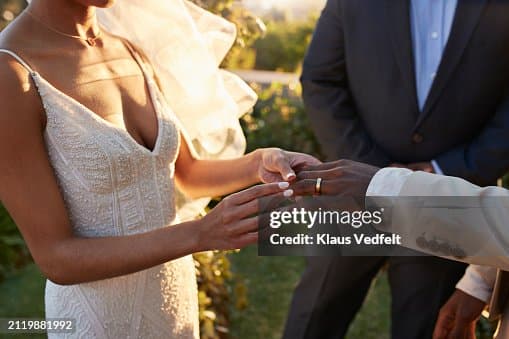
It is a familiar phrase in Ghana, usually referring to the ceremony where two families come together, customary rites are performed, and a couple is formally united.
But there is something fishy about the word engagement.
In the Western understanding of the term, an engagement happens before marriage. A proposal is made, it is accepted, and the couple becomes engaged while preparing for their wedding.
Due to social media, engagements can become highly publicized, where the man is seen on one knee in a well-decorated setting and asking a woman to marry him, with their friends shouting, "Say yes, say yes."
In Ghana, however, “engagement” can refer to a customary ceremony through which a couple is actually married.
So, when did marriage become an engagement?
The Westernized Transition
READ MORE: White vs Traditional Marriage: Aesthetic Above Culture?
Traditionally, marriage in Ghanaian communities was a family affair. It could involve negotiations between families, the presentation and acceptance of customary items and rites that formally recognized the union.
These customs differ across ethnic groups. Among the Akan, for example, kɔkɔɔkɔ, or “knocking,” involves the groom’s family approaching the bride’s family to formally request her hand in marriage.
The customary marriage itself could then follow, making the process more than simply a promise of a future wedding.
In a 2022 study, Shirley Dankwa, Vincent Odoom, and Isaac Eshun examined parallel marriage ceremonies in Winneba. The researchers found that most participants referred to customary marriage as “the engagement.” They also found that some participants were unaware of the legal recognition of customary marriage.
The finding raises an interesting question: why do we use a word that describes a step towards marriage to describe a ceremony that can itself constitute marriage?
When Marriage Became Two Ceremonies
The answer may lie partly in the way marriage has evolved.
Dankwa, Odoom, and Eshun describe “parallel marriage ceremonies” as the practice of performing more than one marriage ceremony, particularly among Christian couples. Customary, ordinance, and church ceremonies can form part of this process.
As couples increasingly combine customary marriage with a church or ordinance ceremony, the two have become separated in everyday language. The customary ceremony becomes the “engagement.” The church ceremony becomes the “wedding.”
READ MORE: Soft Life - A Form of Empowerment or Pressure?
This creates a sequence that is different from the ordinary Western understanding of engagement. There, an engagement is the period between accepting a marriage proposal and getting married. In Ghana, the word is often attached to a ceremony that comes immediately before a white wedding but may already carry the substance of customary marriage.
The researchers recommend that marriage counsellors help couples understand that customary marriage should not simply be viewed as an engagement.
More than a word
Perhaps, then, the issue is not whether Ghanaians are using the word “engagement” incorrectly. It is what the word has come to represent.
For many couples today, the customary ceremony is followed by the white wedding, the gown, church, photographs, and reception. The customary ceremony becomes the first event, while the white wedding is often treated as the main wedding.
But language shapes perception.
Calling a customary marriage an “engagement” can make it sound like the couple is still waiting to become married, even when the customary requirements for marriage have been fulfilled.
The findings of Dankwa, Odoom, and Eshun (2022) show that this understanding is reflected in how some Ghanaians themselves describe their marriages.
Now the question becomes, "When did we stop calling our marriages engagements?”
Edem Kwame
Chief Editor
Edem Kwame is a staff journalist at GH News Media, where he covers news, sports, politics and current affairs with a sharp focus on Ghanaian and African football.