
White vs Traditional Marriage: Aesthetic Above Culture?
By Agnes Fynn
“I don’t believe a white wedding is necessary. I believe our traditional marriages are beautiful and complete. Yet, when I imagine my own wedding, I still picture myself in a white dress.
My view that a white wedding is unnecessary is driven by the Pan-Africanism and love for Ghanaian culture in me, yet my interest in the white wedding is driven by the beauty that comes with it."
In Ghana, marriage does not begin with a bride walking down an aisle. It can begin with a knock at the door.
Across Ghana’s ethnic groups, traditional marriage ceremonies may differ in name and detail, but they share a common thread: marriage is not treated as a union between two individuals alone, but as a coming together of families. Among the Akan, this is known as kɔkɔɔkɔ, while the Ewe refer to their form of knocking as vɔƒoƒo.
The Ga have Agboshimɔ, followed by rites involving acceptance, the presentation of a cover cloth and traditional food.
Among the Mole-Dagbani, customs include Diɛŋ, Nyuyu ɲmabu, Dɔyiripaya and payipin, while traditions among the Guan vary across their different communities. Despite these differences, the ceremonies generally involve families formally meeting, seeking approval and presenting gifts or items as part of the marriage process.
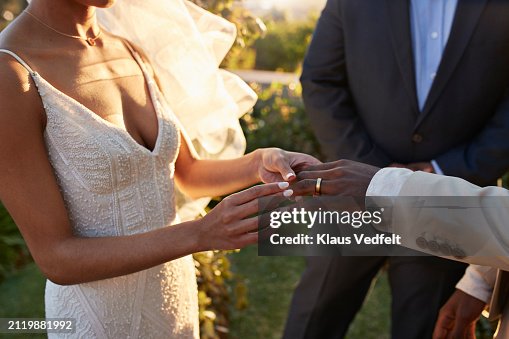
Then came another form of marriage: the white wedding, which involves the aisle, the white dress, the church, the vows and the words, “By the power vested in me…”
And somehow, for many Ghanaians, the white wedding has become the picture many people grow up imagining when they think of what a “proper” wedding should look like.
READ MORE: Marriage or Engagement? How Ghana Came to Call Customary Marriage an Engagement
After families have gathered to recognise the union, another ceremony often follows, one in which the couple publicly makes vows to each other.
Mary, a university student, says she would like to experience a white wedding because she finds them beautiful and likes the idea of wearing a gown.
Like other Ghanaian women interviewed for this story, she does not consider the white wedding necessary, viewing it instead as an aesthetic choice.
Marriage Under the Ordinance
According to the Judicial Service of Ghana, the Marriage Ordinance, Cap. 127, provides the statutory framework for marriages under the Ordinance.
An ordinance marriage is monogamous, while a customary marriage is potentially polygamous.
The Judicial Service notes that marriages conducted under the Ordinance have the same legal validity whether they take place in an orthodox church, metropolitan assembly or court.
In other words, an ordinance marriage does not become legally valid simply because there is a white gown, a church, an aisle or a bridal train.
Yet for some Ghanaians, the appeal of the white wedding extends beyond its legal status.
READ MORE: Soft Life - A Form of Empowerment or Pressure?
For Sarah, a university graduate, it is largely about the beauty and emotion associated with the ceremony.
“I feel like it is just beautiful, being in your white dress and having your daddy or this man walking you down the aisle with your man standing there. Like those ones where the groom sees you and he starts crying? How crazy, but yeah, it is beautiful. A white wedding is beautiful, so that’s what appeals to me.”
But aesthetics are not the only factor. For Sarah, her Christian faith also influences her desire for a white wedding.
“I am a Christian, and a white wedding is not all the time, but most of the time it takes place in a church. And there’s this man of God blessing your marriage, and it’s like you are getting married in front of God, like God is in your union, and I feel like that is good, that is beautiful. So, I’d say yes, maybe my religion is part of why I may want a white wedding.”
For some Christians, therefore, the church ceremony carries significance beyond the aesthetics of the wedding. Some churches have specific requirements concerning marriage, where couples who have not undergone a church wedding cannot take the Holy Communion.
Does the Bible Require a White Wedding?
The Bible contains several passages that speak about marriage, companionship and the responsibilities of husbands and wives. Genesis 2:24 speaks of a man leaving his father and mother and holding fast to his wife, while Ecclesiastes 4:9 describes the value of two people working together. Proverbs 18:22 speaks positively of finding a wife, and Ephesians 5:25 instructs husbands to love their wives.
These passages affirm marriage and the responsibilities that come with it, but they do not prescribe a specific modern wedding format, whether a couple must marry in a church, wear a white gown, walk down an aisle or have a particular type of ceremony.
There is nothing wrong with a white wedding; in fact, it is beautiful, sophisticated and memorable. What matters is the couple involved, their financial readiness and their motivation for desiring both the traditional and white wedding.

Edem Kwame
Chief Editor
Edem Kwame is a staff journalist at GH News Media, where he covers news, sports, politics and current affairs with a sharp focus on Ghanaian and African football.