
10 state institutions owe over GH¢3bn in unpaid taxes as Ghana's financial irregularities hit record GH¢5.2bn
More than half of the record GH¢5.2 billion in financial irregularities recorded across Ghana's ministries, departments and agencies in 2025 stemmed not from procurement breaches or payroll anomalies but from unpaid taxes owed by just ten state institutions.
According to the auditor-general's latest report on the public accounts of government ministries, departments and agencies, total irregularities reached GH¢5.2 billion in 2025, the highest level recorded since at least 2021.
The figure represents an increase of more than 156% compared with the previous year and is more than three times the average annual irregularities recorded over the past five years.
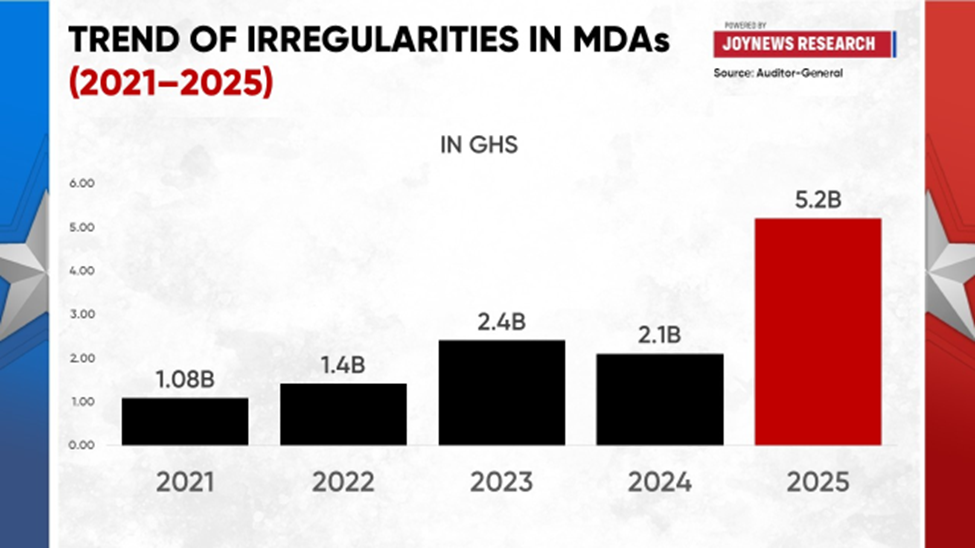
The sharp increase was overwhelmingly driven by tax irregularities.
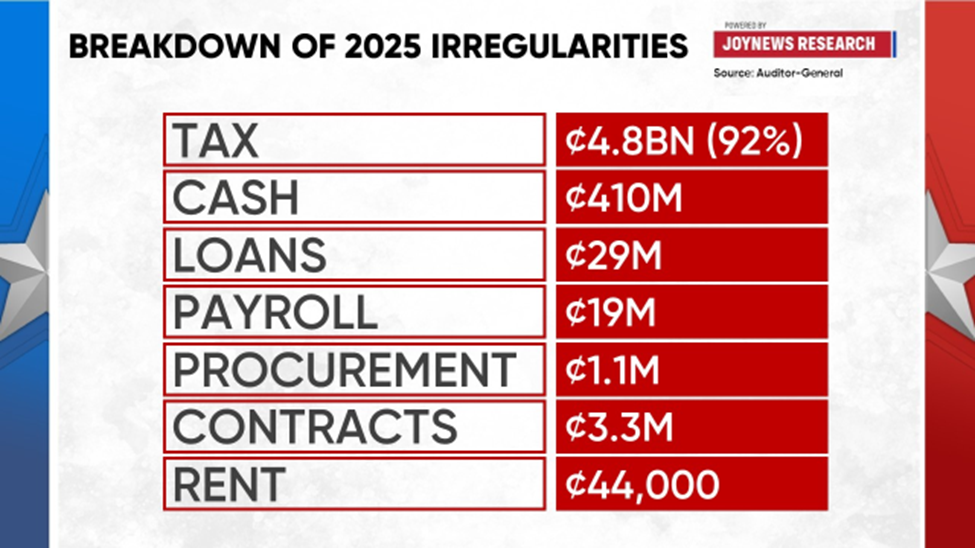
According to the report, tax-related irregularities totalled approximately GH¢4.8 billion, accounting for about 92% of all irregularities identified during the audit.
More significantly, over GH¢3 billion of those tax irregularities relate to outstanding tax obligations accumulated by ten state institutions during 2024.
In other words, more than half of all the irregularities reported in the Auditor-General's 2025 report actually originated from taxes that were due the previous year but had not been remitted.
The Electricity Company of Ghana accounted for the single largest outstanding liability.
According to the Auditor-General, ECG failed to remit approximately GH¢1.4 billion in taxes, representing nearly half of the total unpaid tax obligations identified among the ten institutions.
The Ghana Airports Company Limited recorded the second largest outstanding tax obligation at about GH¢430 million, followed by the Produce Buying Company Limited with approximately GH¢330 million.
Other institutions cited in the report include GIHOC Distilleries Company Limited, Tema Oil Refinery, AirtelTigo Ghana and Graphic Communications Limited.
While the unpaid taxes dominated the report, the auditor-general also identified irregularities across several other categories.
Cash irregularities amounted to approximately GH¢410 million, while loan irregularities stood at GH¢29 million.
READ MORE: China sentences official to death over $325 million bribery scandal
Payroll irregularities totalled about GH¢19 million, procurement irregularities reached GH¢1.1 million, and contract irregularities amounted to approximately GH¢3.3 million, while rent irregularities stood at about GH¢44,000.
Collectively, however, these categories represented only a small fraction of the overall irregularities compared with the scale of the outstanding tax obligations.
The findings suggest that the principal driver of the sharp increase in irregularities was not widespread growth in procurement or payroll breaches but the accumulation of unpaid taxes by state-owned enterprises.
That is particularly significant given the government's continued emphasis on strengthening domestic revenue mobilisation and improving tax compliance across the public sector.
The report therefore raises questions about tax compliance within state institutions themselves, particularly as government continues to pursue broader revenue mobilisation reforms across the economy.
In recent years, authorities have introduced several tax administration measures aimed at improving compliance among private businesses and individuals. The Auditor-General's latest findings suggest that significant compliance challenges also persist within parts of the public sector itself.
Source: JoyNews
Edem Kwame
Edem Kwame is a journalist at GH News Media covering news and national developments in Ghana.